
Except Sometimes
Involuntary memory and unresolved love songs

Paris, early twentieth century. Marcel, the narrator of a novel whose author shares his first name, tastes a madeleine sponge cake that’s been dipped in tea. He starts to feel disoriented, like he’s stepping out of time. He realises he’s encountering an unsought memory. It takes him back to his childhood in what will later be called, after his creator, a Proustian rush.
The sensation is exquisite. He wants to repeat it. Like so many fictional characters who discover magic portals, he longs to return, to repeat the moment, extend it, perhaps never leave it. On the one hand, Marcel is not looking for a fantasy world. He’s going in search of lost time. But the past is another country, as another writer will tell us in 1953, a place where they do things differently.
Paris, 2022. Kim Willsher reports for the Guardian on an exhibition to mark the centenary of Marcel Proust’s death. On show are notebooks that trace the prehistory of the petite madeleine.
In 1907, when he was working on the first volume, Swann’s Way, it was the dunking of pain rassis, a piece of stale bread, into tea that provoked his elation. In the next version, it had become pain grillé, or toast, then some time around 1908 it was a biscotte, a kind of hard biscuit.1
‘The rest’, writes Willsher, ‘is literary history’. It is, but we learn from this report that evocative objects are both interchangeable and highly specific.
Paris, 1927. The final volume of A la recherche du temps perdu is published. Proust is five years dead. The madeleine has become the poster cake of involuntary memory. The seven volumes of La recherche have become the model of can be done with voluntary memory, the proactive quest to revisit the past and the self, to go in search of lost time.
Berlin, 1929. Walter Benjamin publishes his essay ‘The Image of Proust’, in which he writes the following:
When we awake each morning, we hold in our hands, usually weakly and loosely, but a few fringes of the carpet of lived existence, as woven into us by forgetting. However, with our purposeful activity and, even more, our purposive remembering, each day unravels the web, the ornaments of forgetting.2
Forgetting is the norm. Without forgetting, there would be no involuntary memory as Proust formulated it. We need to have forgotten in order for objects and sensations to do their evocative work.
Benjamin speaks of Proust’s convoluted time. Objects mixed up in a haze of temporalities, past folded into present into past.
1952. The Las Vegas Story. A Howard Hughes movie starring Jane Russell, Victor Mature and Hoagy Carmichael. About 15 minutes in, Russell’s character Linda walks into the Last Chance Casino, where Happy the pianist (played by Hoagy the pianist and songwriter) is tinkling the keys of a familiar tune.
Echoes of Ilsa and Rick and Sam in Casablanca a decade before. Songs as evocative objects, dangerous things. ‘You must remember this’, sings Sam. ‘Do you remember this?’ Happy asks Linda. ‘Of course I do’, she sings.
‘I Get Along without You Very Well’, a Hoagy Carmichael classic that first appeared in 1939. It offers superficial bravery in the face of loss, boasting about a survival that is tempered by the song’s famous list of exceptions: I get along without you, ‘except when soft rains fall’, ‘except when I hear your name’, ‘except perhaps in Spring’.
By the time Jane Russell sings it, it’s already been a hit for Red Norvo and his orchestra. Three years later it will appear on Frank Sinatra’s blue masterpiece In the Wee Small Hours of the Morning alongside other tales of the memories that come unbidden in the middle of the night. It offers the perfect vehicle for Billie Holiday’s late voice on 1958’s Lady in Satin. In 1969, it’s a central pillar of Nina Simone and Piano! In 1981, Carly Simon includes it on her album Torch where it sits next to other hymns to unrequited or unresolved love. Songs like Steven Sondheim’s ‘Not a Day Goes By’, which finds Simon asking the permanent question of this kind of song: ‘Where’s the day I’ll have started forgetting?’
Simon’s album is a paean to a kind of song known as the torch song.
Early 2000s, Newcastle. I read John Moore’s article on torch singers, ‘The Heiroglyphics of Love’. It’s possible I read it in the pages of Popular Music, but I now recall it more as a text included in Richard Middleton’s edited collection Reading Pop. When I first read it, I’m about to move to Newcastle to study with Middleton and to think about loss, memory and nostalgia.
So begin more than two decades of trying to come to terms with songs like the ones I’m recalling here, many of which had already affected me before this time, songs whose affect would have had no small agency in leading me to this point. Reading Pop, meanwhile, becomes an evocative object for me.
Moore sets borders around the torch song and who could be defined as a torch singer.
In terms of lyrical content, [Moore writes] a torch song can be characterised as a lament sung by a woman who desperately loves a commonplace or even brutish man. The latter treats her badly, leaves her or no longer cares for her. Occasionally, he ignores or rebuffs her tentative advances. And yet she remains inexplicably enslaved to him. In short, a torch song is an elegy to unrequited or no longer requited love. Its concerns are entirely romantic, and do not include the earthiness or playful eroticism of contemporary blues lyrics.3
The lyrical device I’m chasing – the one that dramatizes recall as intrusion, an event that interrupts the singer’s present-tense composure and exposes the fragility of emotional distance – can be found in many types of song. I find myself wanting to look further. If the lineage of songs I’m following exceeds the boundaries of the torch song (as defined by Moore), then I need to think about other names. I settle, provisionally, on ‘unresolved love songs’. I like the suggestion of a musical grammar that seeks resolution as well as a lyrical one. Not that these songs are unresolved musically – they’re neat pieces of art, perfect little packages. But they invite return, they offer themselves as always open, there to listen and to be listened to. They promise comfort but not closure.
2007. MIT Press publish a collection of essays edited by Sherry Turkle: Evocative Objects: Things We Think With. Each contributor chooses an object that allows them to say something about their lives or that prompt observations about the world in general. Although not exclusively about tangible objects, most of the essays refer to physical things: a cello, knots, a laptop, ballet slippers, a rolling pin, a stuffed bunny, a glucometer, a yellow raincoat.4
Turkle isn’t as transparent as she could be about earlier work on ‘evocative objects’ by the psychologist Christopher Bollas. He gets a mention in the references at the end of the collection, but not much more. Bollas’s work from the late 1970s onward showed how objects help us navigate the past, present and future. He sees objects as both ‘transformational’ (meaning that we can use them to transform our experience and ultimately ourselves) and ‘aleatory’ (meaning that objects can take us by surprise and on unexpected journeys). While we can select objects for our strategic use (or according to our desires), we can also become subject to ‘aleatory objects’ which catch us unaware, surprise us and entice us.5
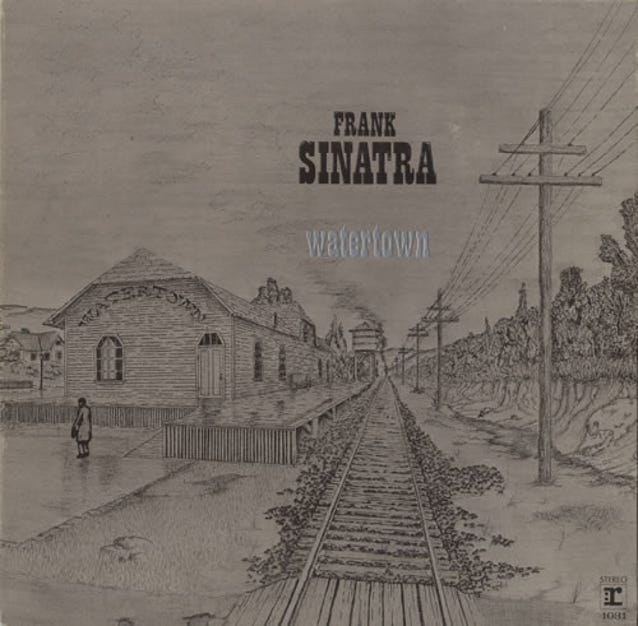
1969, Watertown. Born of a concept pitched to Frank Sinatra by Bob Gaudio and Frankie Valli of the Four Seasons. Gaudio teams up with lyricist Jake Holmes. The album’s songs tell the story of a rural middle-aged man whose wife has left him and their children for a new life in the city. The abandoned male theme is familiar to Sinatra and his audience, but the rural setting of the story and the subject position are both new. The man can no longer run away. The everyday domestic life is one of getting by and trying (unsuccessfully) to forget. This is hymned most poignantly on ‘For a While’, a song that finds the singer trying to live life as normal. Days pass ‘with no empty feeling’ but inevitably he remembers his loss.
Discussing the album years later, Holmes says:
I’ve always felt that there is that moment in your life, when you forget about something that is really terrible. For five minutes the sun is shining and everything is beautiful. Then all of a sudden you realize that the person you cared about is gone, and it all comes back. It is one of those horrible things about grief – one of those little holes in grief when it becomes even more painful.6
These little holes populate all the songs on the album; sometimes the singer’s in danger of plunging in, sometimes he’s able to patch them. Here, Sinatra’s on familiar territory and, as with the best of his later work, the vocal mastery, in ‘writing’ the songs in definitive form, recalls the Proustian project of capturing the past to insulate oneself against the trauma of involuntary memory. If the singer can spin his version of the story and get it all down while still allowing time for sentiment, perhaps he may find a template to live by.
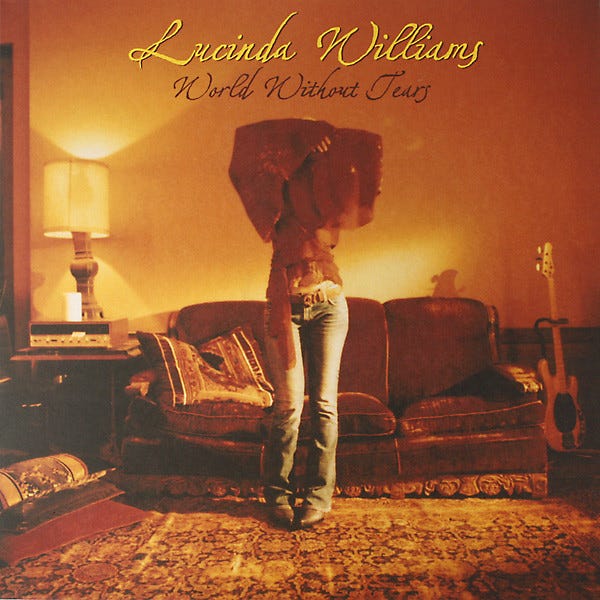
2003. Lucinda Williams releases World Without Tears, an album of characteristically evocative songwriting. It contains a song called ‘Overtime’, written as one word as if to describe a kind of additional labour, working overtime. It is that but it’s also what might happen over time (two words), the work of forgetting. ‘I guess one afternoon, you won’t cross my mind’, Williams sings. A related line in the song: ‘I guess out of the blue you won’t cross my mind’. That’s a neat twist on how it’s usually the involuntary stuff that comes out of the blue: here it’s going to be the unexpected arrival of blissful oblivion.
But wouldn’t you know it? The points in the song where Williams’ voice shifts into high lonesome are when she’s listing the features of the person she’s trying to forget: ‘Your blue eyes, your black eyelashes, the way you looked at life … Your pale skin, your sexy crooked teeth, the trouble you’d get in’. It’s a list song as helplessly wrapped up in the minutiae of the remembered as ‘These Foolish Things’ or ‘I Get Along Without You’.
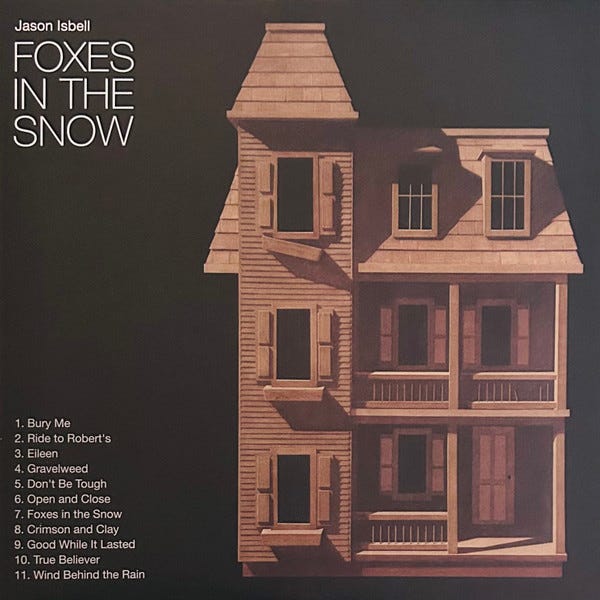
2025. Jason Isbell releases Foxes in the Snow , a series of songs about people thinking about each other across temporal and geographical distances. Many of them call to mind a line from the first volume of Proust’s massive novel: ‘the anguish that comes from the feeling that the person you love is in a place of enjoyment where you are not, where you cannot follow’ (p. 33).
In ‘Good While It Lasted’, Isbell sings, ‘for a minute in the afternoon, I almost didn’t think of you’.
2012. Mary Chapin Carpenter releases Ashes and Roses, an album that contains a song called ‘What to Keep and What to Throw Away’. The song offers advice on how to deal with a loss (it’s divorce but could equally apply to bereavement or other separations). It underlines how we have to deal with the traces that people leave behind, while also being aware of the painful memory work that objects can bring about.
Carpenter’s narrator isn’t wallowing in misery. She’s practical: ‘These are your instructions’, she sings, ‘Sit down with pen and paper / Begin with something hollow / Like the last words that he offered’.
There are several objects and pseudo-objects contained within the lyrics: a winter coat, a crumpled note in a pocket that says ‘milk and Sunday paper’. ‘Fold it up and box it before you’ve time to think’ Carpenter sings, ‘Avoid familiar back roads / Erase the old phone numbers / Delete all the photos’. There are more instructions: ‘Fill up every journal, Empty every shoebox, Burn the lists and letters, Sweep out all the old thoughts’. What at first appears to be stoicism is challenged by glimpses of what lies beneath, what may come creeping to the surface. One of the instructions is to take a deep breath.
It’s a struggle, just like that laid out in ‘I Get Along Without You Very Well’. You can try to control voluntary memory, but beware of involuntary memory, the traps that lie in wait when you look too closely into what you’ve lost.

This is where, if time were on my side, I might mention Doris Day’s instructional song, ‘Put ‘Em In A Box, Tie ‘Em With A Ribbon (And Throw ‘Em In The Deep Blue Sea). Or Iris DeMent’s ‘No Time to Cry’ from 1995. Or Taylor Swift’s ‘All Too Well’ in its 2012 and later incarnations, a song that grows its memories and evocative objects like some kind of hyperprocessed protein bar of remembering.
This is how you build life narratives from fragments.
I’ve mentioned a small number of songs. I know many more that use this device, including examples that stretch beyond the borders of American song. You’ll know others. My selection is what came to me out of the blue, in all the possible meanings of that resonant phrase. Perhaps the trope whose tail I’m chasing is too specific, or too widespread or too banal, to be of interest. But things that come to us out of the blue deserve to be taken seriously, as do things that invite us to traverse portals and scramble time.
I get along without Frank Sinatra and Billie Holiday and Nina Simone and Jason Isbell very well. Of course I do. Except when I don’t. Except when I need to hear about how each of these specific performers have configured the mechanics of the unresolved love song. Isn’t that the same for all our favourites, for all those musicians who’ve caught us unaware, awoken something in us, made us want to return to that experience again and again, because they have shone a light on something that has made an ordinary affect an extraordinary one, a transformative object that rejigs how we perceive our world. Proust wrote about that too, but that’s a topic for another day.
The above is the text and musical examples from a presentation I gave at the IASPM UK & Ireland conference, University of Aberdeen, 30 June 2026.
Kim Willshitre, ‘In search of lost toast: Paris show reveals origins of Proust’s madeleines’, The Guardian, 10 October 2022, https://www.theguardian.com/books/2022/oct/10/in-search-of-lost-toast-paris-show-reveals-origins-of-prousts-madeleines.
Walter Benjamin, ‘The Image of Proust’, Illuminations (Schocken. 2007), 202.
John Moore, ‘“The Hieroglyphics of Love”: The Torch Singers and Interpretation’, Popular Music 8, no. 1 (1989): 31–58, https://doi.org/10.1017/S0261143000003147.
Sherry Turkle, ed., Evocative Objects: Things We Think With (MIT Press, 2007).
This work is summarised in Christopher Bollas, The Evocative Object World (Routledge, 2009).
Jake Holmes quoted in liner notes to Frank Sinatra, Watertown (CD: Reprise, c.1990).
Enjoyed this very much and am sitting here — having just finished reading — thinking about it. First, just to say that the title of The Guardian article in the first footnote made me laugh out loud.
Second, more substantively: I have such a tiny repertoire of songs in my head compared to you, though probably a larger number than most of traditional or folk or folksy songs (as in the kind that were included in the wonderful book ”Rise Up Singing”) and so lack access to many musical reference points. But when you framed it first with Proust and Benjamin, the music question became accessible, and I loved the discussion.
I suppose I would think of Eartha Kitt's ”Say, Jacques, have you seen Louis?” as a classic but simple torch song, as you define it here, ie, with all the desperation but very little depth. (”I try, but I can't forget. I love him yet.”)?
But for your larger definition of unresolved love songs, it's made me think of Gordon Lightfoot's ”Second Cup of Coffee.” (”I'm on my second cup of coffee and I still can't face the day.”) Initially it is about ruminating on a lost love, but expands to ruminations in general, and also — maybe! — into a reasonable stand-in for feeling unable to face the day even without the memory/rumination aspect. I come back to that song precisely because it seems bigger than unrequited love, but I'm curious now to think of whether that makes it weaker or stronger (intellectually/emotionally) than the focused songs you've been writing about here, most of which I hadn't heard before.
Sorry for rambling on — just to say that this has been a really nice first read of the day, thank you!