
Ancient Axe
My year of the harp.

November, 2025. The curators at Qobuz, my current music streamer of choice, place Mélanie Laurent’s Pastel in the ‘Discover’ section. Laurent is a French harpist and the pieces on her debut album are by French composers: Claude Debussy, Maurice Ravel, Germaine Tailleferre, Cécile Chaminade, Marcel Tournier. The timing’s just right. I’ve been listening to a lot of harp music this year, imagining a piece called ‘Ancient Axe’.
I like this feature of Qobuz’s ‘Discover’, placing new classical releases among the pop, jazz and trad ones. Spotify never did this for me. Perhaps I didn’t train it well enough. I know little of the classical harp repertory. Laurent’s album provides some portals I’d like to explore in the future. For now, though, I’m thinking about harp-featuring tracks that I recall from my more usual listening fare or that I heard as new releases this year.
I’m borrowing ‘ancient axe’ from Ira Gitler’s liner notes to In a Minor Groove, a Dorothy Ashby album from 1958 that was reissued, along with other early Ashby albums, in New Land’s With Strings Attached boxset in 2023. I’ve been listening to those six albums a lot this year.


Ashby’s take on Margarita Lecuona’s ‘Taboo’, a song I first encountered on Arthur Lyman’s album of the same name. Jazz and exotica as mutually attractive forces. Ashby delineating what the harp would be for jazz: washes of colour, new textures and ways of taking melodies for journeys. On some of these early albums, other instruments dominate for periods (flute, vibes), but the harp is always the guiding force.
‘Feeling Good’, a song owned by Nina Simone but excavated differently by Ashby on her 1965 album The Fantastic Jazz Harp of Dorothy Ashby.
Ashby’s harp is the first sound heard on Bobby Womack’s The Poet II: ‘Love Has Finally Come At Last’. The first sound, too, on Stevie Wonder’s ‘If It’s Magic’.
Alice Coltrane at New York’s Carnegie Hall, 1971. A fifteen minute version of ‘Journey in Satchidananda’, the title track of her recently released album. The music comes in like waves: the steady pulse and surge of the bass, the splash and spray of the harp. Coltrane’s playing reflects the paradoxical logic and randomness of water: laps, eddies, currents, swirls, the pull of gravity, the seeking of levels. If we think of bathing, floating, soaking, submerging, washing, it’s all part of the creators’ plan. ‘Anyone listening to this selection’, she writes in the liner notes to Journey in Satchidananda, ‘should try to envision himself floating on an ocean of Satchidanandaji’s love, which is literally carrying countless devotees across the vicissitudes and stormy blasts of life to the other shore. Satchidananda means knowledge, existence, bliss.’
Brandee Younger takes on the legacies of Ashby and Coltrane. Brand New Life (2023) is an Ashby homage (DA originals and tracks she featured on like ‘If It’s Magic’). On Gadabout Season (2025), Younger plays Coltrane’s restored harp. As much as I enjoy these albums, it’s her set of Covid-era quarantine tunes with bassist Dezron Douglas I return to most often this year: something about the intimacy of lockdown duets and the selection of tunes: John and Alice Coltrane numbers sitting alongside Kate Bush’s ‘This Woman’s Work’ and The Stylistics’ ‘You Make Me Feel Brand New’.
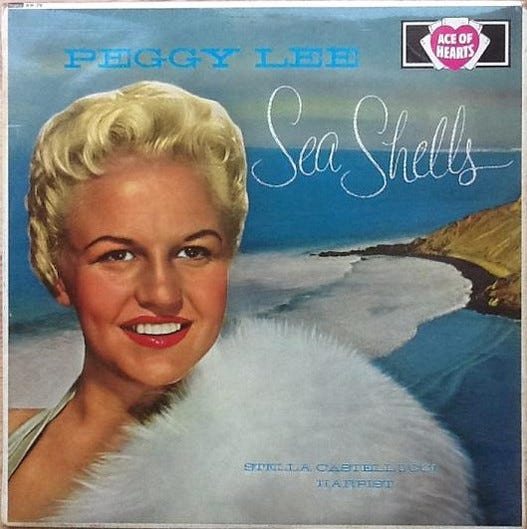
One seed for what became my Year of the Harp: the strange Peggy Lee album I bought in a charity shop in Truro in early January. Sea Shells (1958) finds Lee performing songs and reading translations of Chinese poems to the accompaniment of Stella Castellucci on harp and Gene Di Novi on harpsichord. ‘We used the harp in this album’, Lee writes in the liner notes, ‘to capture the mood of the sea—and because it’s just wonderful to sing with the harp’. The oceanic harp, songs as seashells found on the shore. Of Castellucci’s playing, Lee highlights ‘the lovely surf sounds and oriental flavour’. A nod, perhaps, to those exotica and mood music albums of the time, where harps abound to denote the celestial, the dreamy, the romantic, the ocean-lapped.
When I listen to Mary Lattimore’s albums, oceanic metaphors are never far from my mind. I berate myself for falling into cliché, for not finding new language to reflect the listening experience, while at the same time resigning myself to words like ‘sparkling’, ‘incandescent’, ‘shimmering’, ‘glistening’, ‘celestial’. Lattimore doesn’t exactly help with her song titles: ‘It Feels Like Floating’, ‘Hello from the Edge of the Earth’, ‘Their Faces Streaked with Light and Filled with Pity’ (all from Hundreds of Days, 2018); ‘And Then He Wrapped His Wings Around Me’, ‘Music for Applying Shimmering Eye Shadow’, ‘Horses, Glossy on the Hill’ (from Goodbye, Hotel Arkada, 2023). That is to say, she absolutely helps: I love these titles as much as I love the music. Just don’t ask me for new language when describing it.
An album by Lattimore and Julianna Barwick is due for arrival in 2026. Pre-release tracks augur well.
I’ve seen Robin Williamson live twice. The first time was in the early 1990s in a hall in North Devon. Barnstaple, if memory serves. The stage was strewn with instruments which Williamson navigated during the course of the evening, moving from stories to songs to instrumentals. No live performance I’ve seen since has matched it for eclectic panache. Even the In Concert video released by Shanachie Records in 1990, brilliant as it is, doesn’t capture the beautifully ordered chaos of that half-remembered gig.
I have the first of Robin Williamson’s two Legacy of the Scottish Harpers LPs. The harpist as teacher. The album as pedagogy. Extensive liner notes on the harp’s history and the provenance of the fourteen tracks, with bibliography and glossary. Among the many things Williamson shares are the ‘numerous references to the harp’ in the old Welsh laws: ‘its study being permitted only to freemen; its ownership, together with a chess-board and a cloak, being the three marks of a gentleman; its being the one possession not seizable for debt’.
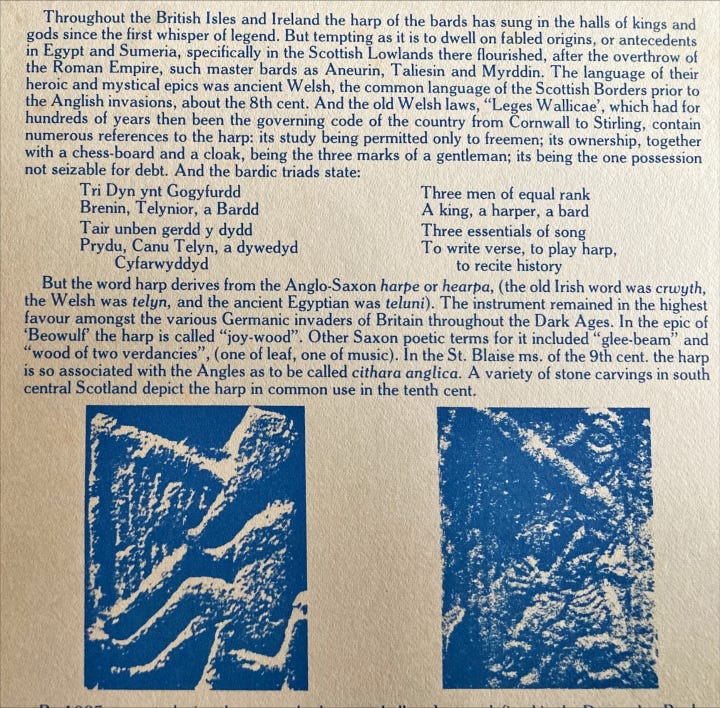
‘Three essentials of song / To write verse, to play harp, to recite history’. No lyric poetry without the lyre.
Williamson’s Songs of Love and Parting (Cladagh, 1981). I’d have probably wanted it for the title alone, but the harp-based songs—‘Verses in Stewart Street’, ‘Return No More’, ‘Sigil’, ‘Flower of the Briar’, ‘Gwydion’s Dream’, ‘The Parting Glass’—are outstanding, and it also contains ‘For Mr. Thomas’ (revisited two decade later on Williamson’s ECM album The Seed-At-Zero). When Van Morrison covers ‘For Mr. Thomas’, he changes ‘rough god go striding’ to ‘rough god go riding’. He later writes a song called ‘Rough God Goes Riding’, and Greil Marcus publishes a book about Morrison that uses that song’s refrain for its title.
Harp as pedagogy for rock fans. Alan Stivell was there from the early 1970s. I don’t recall where I first encountered his Renaissance of the Celtic Harp. I think my parents had a copy. I do recall that, once I started frequenting record shops, markets, car boot sales and charity shops, Renaissance was a ubiquitous presence. At some point, I ended up with two copies: a French and an English edition. Harp revival with a rock aesthetic at a time when rock was looking in all directions and searching all eras.
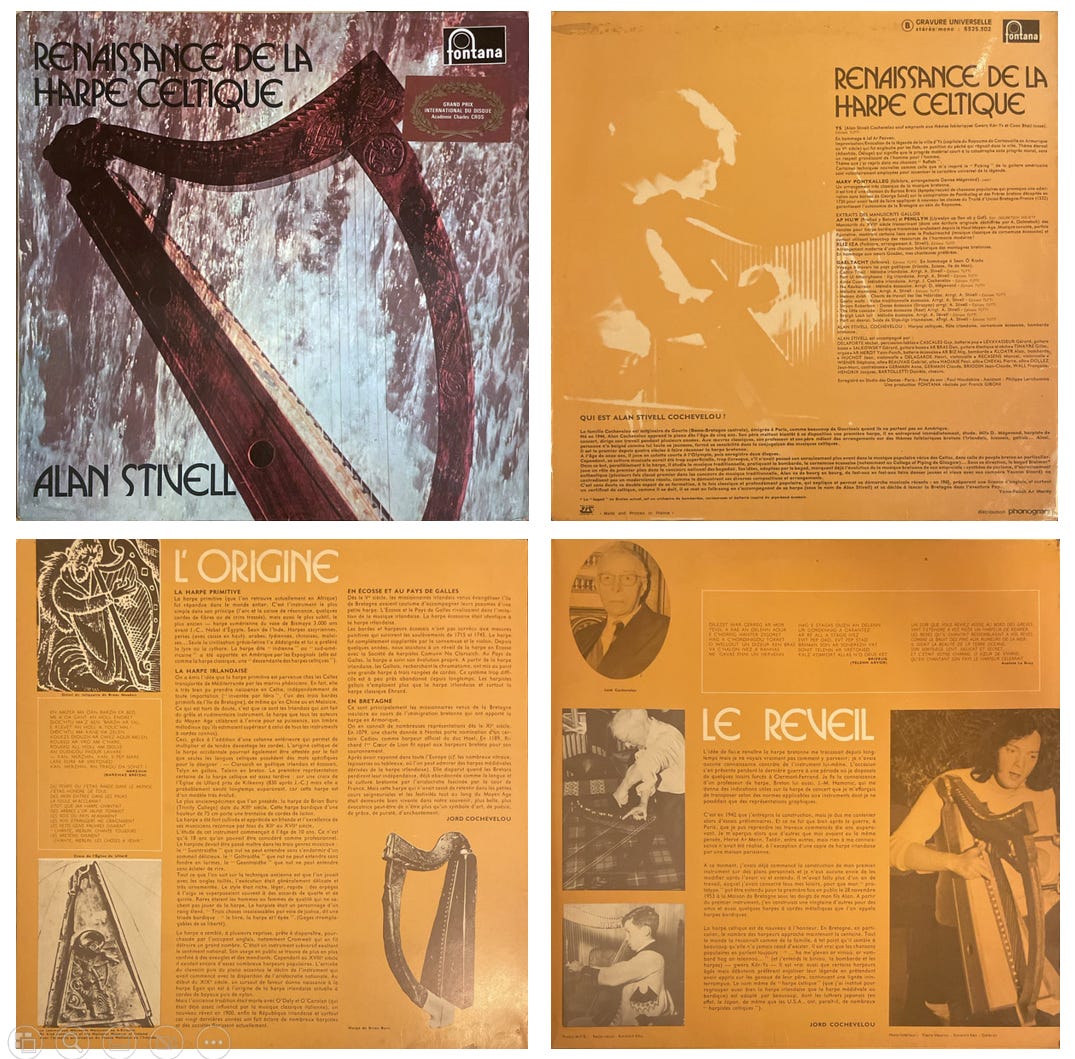
Stivell and Williamson doubtless primed a certain type of listener (was I one?) for Joanna Newsom’s arrival in the early 2000s. Yet nothing could deflect from the absolute unexpectedness and originality of her debut album The Milk-Eyed Mender. (Drag City, 2004). It’s still the album I go back to when I want to relive that sense of wonder, no matter how brilliant the work that came after was. (And it was: Ys, the follow-up, is a masterpiece of ambitious songwriting. I was surprised when she said in an interview with The Wire that that the album’s title wasn’t a nod to the opening track on Alan Stivell’s famous album, but something that came to her in dreams).
She sang of meteorites and bears and ringing bells, of her and him and you, and she played not for us, it seemed, nor for herself exactly, but for the very presences her music conjured. Her songs were not performed so much as drawn from herself like nets dredged from the sea, heavy with kelp and flotsam and minnows that flashed before darting back into the deep. When she occasionally stumbled and lost her way, the material itself would pick her up again and carry her forward.1
I remember reading this brilliant piece by Erik Davis when it was new. Lovely to revisit it, and to have Jay Babcock’s classic Arthur available again.
Babcock himself interviewed Newsom at the time of her 2004 debut. I like what she said about building songs from objects:
I saw a painting the other day of this gypsy lady that had a skirt covered in pockets everywhere and there were little things in all her pockets. Sometimes I feel like that: I have little objects and every once in a while I take them out of my pockets, lay them all in a row and I like the way they look next to each other, so that’s a song! [laughs] But I’ve had them in my pockets for such a long time.2
Harp memories keep flowing. The time in 2007 I saw Joanna Newsom perform with the Northern Sinfonia at what was then Sage Gateshead, with Alasdair Roberts providing spellbinding support. As well as performing the Ys album, Newsom played a non-orchestral set of older songs, a new song and a setting of Isabel Pagan’s ‘Ca’ the Yowes’. Years later, YouTube provides a version of that song from an earlier show.
Another 2007 gig. Baby Dee upstairs at The Cumberland Arms in Newcastle. Eccentric, meandering, beautiful harp songs. The following year would bring Safe Inside the Day. For all I continue to love that album (its title track a near pinnacle of songwriting as far as I’m concerned), I’ve always wished there were more harp on it. The instrument appears on a couple of tracks, including ‘The Dance of Diminishing Responsibilities’ with its lyric ‘there’s a harp in that piano / there’s a girl inside that boy’ (a theme touched on in the song’s video).
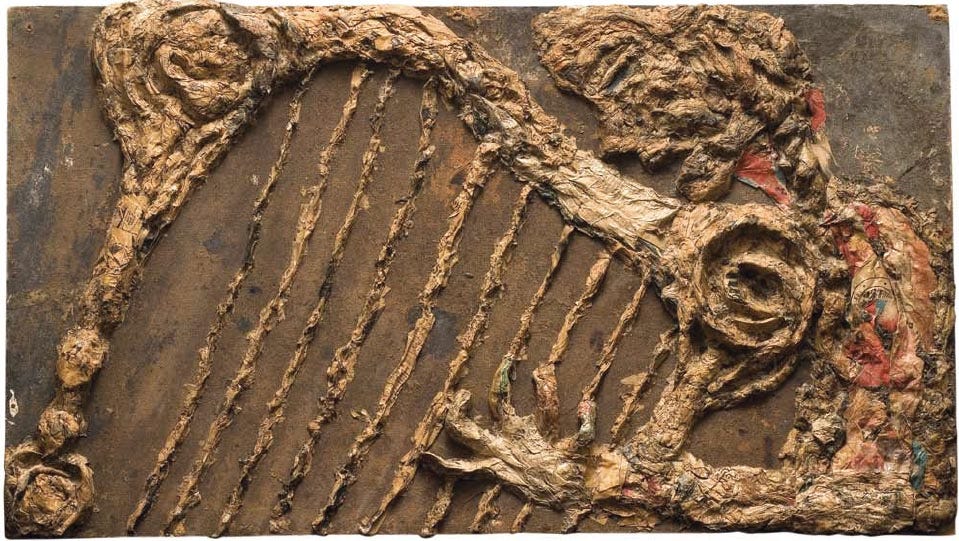
One of my favourite pictures of Violeta Parra shows her with a harp. Her arpillera (tapestry) La cantanta calva (The bald singer) shows a harpist, as does her papier-mâché work La niña y el arpa (The girl and the harp). Though I have several CDs of Parra’s songs and décimas, recordings of her playing the harp prove harder to source. Do they exist?


Harp as loom. A connection suggested in Parra’s work is explicit in Edna St. Vincent Millay’s ‘The Ballad of the Harp Weaver’. A male narrator remembers the sacrifice his widowed mother made one Christmas when, too poor to heat their home or eat, she turned to the harp to weave clothes for her son. He finds her on Christmas Day, frozen in death to her instrument, a pile of garments by her side. Johnny Cash includes his rendition of the poem at the end of his 1963 album The Christmas Spirit and performs it on his TV show in December 1970. The album’s liner notes identify hope, joy, sacrifice and giving as the core themes of Cash’s seasonal selection. Giving and sacrifice play their part in Millay’s ballad; otherwise, quite the downer to close an album (and a TV show) with.
August 2025. On a trip to Edinburgh, I purchase a secondhand record: The Harp Key, by Alison Kinnaird (Temple Records, 1978). An utterly beguiling album. Scottish harp (clarsach) pieces, some solo, some accompanied by other clarsachs, whistle, flute, concertina small pipes, fiddle. The music seems to make even more sense now, in the shortest days of the year. A fire and a glass of Glenlivet. Kinnaird and Aly Bain duetting gracefully on ‘Chapel Keithack’.
I find Robin Williamson another fine companion to winter nights alone, especially his late album Love Will Remain.
The three albums Williamson released with ECM between 2000 and 2006 are remarkable. There’s a fourth, from 2014, that I missed at the time, my ears tuned elsewhere.
To think, when The Seed-At-Zero came out in 2000, it was only a decade (perhaps less) since I’d seen Williamson at that hall in Devon, yet it felt a lifetime away and the music seemed so different. Now more, than a quarter century has passed since that ECM debut.
I came to know Rhodri Davies’ work through his collaborations with Richard Dawson: the guitar and electric harp duets on Dawson’s 2013 album The Glass Trunk; the LP the two released under the title Dawson-Davies: Hen Ogledd (also 2013). Then two Davies LPs on the Newcastle-based Alt. Vinyl label: Wound Response (2012) and An Air Swept Clean of All Distance (2014). On Wound, as on the Dawson collaborations, harp as heavy metal, transducers and electronics warping the strings’ genteel nature into jagged sheets of sound. On Air, a more delicate approach, but the harp still juddering towards something more discordant, a challenge to all those sweet shimmers we associate with the instrument. Uneasy glistening.
Davies’ gorgeous 2024 album Telyn Wrachïod. The title translates to ‘bray harp’, an instrument that dates back centuries. Pegs, or bray pins, are attached to the strings to make them buzz. Likened to the braying of donkeys. Davies on mesmerising form as he delves into Welsh culture. A quote from 17th-century Welsh poet Huw Machno accompanies the release: ‘Precise, angled brays / Speaking every profound feeling’.
Rabbitholing harp history at the Early Music Muse website. Ian Pittaway’s article on the bray harp, fabulously illustrated. A donkey harpist accompanies a goat singer. An ancient Greek swings a lyre like a rock god. All manner of angels pluck harp strings. A naked man is crucified on the strings of a giant harp in Bosch’s The Garden of Earthly Delights.
Rhodri Davies at his most harp-conventional as a member of Richard Dawson’s Ruby Cord band. His graceful contribution to ‘The Hermit’. His vital presence in ‘Museum’.
Harp as archaeological object: Laura Cannell’s Lyre Lyre Lyre (Brawl, 2025) summons subterranean sounds from a replica of the six-stringed Anglo-Saxon lyre uncovered at Sutton Hoo in the 1930s. Another ancient axe.
Cannell on the lyre’s self sufficiency:
It almost resonates on its own, it makes the violin and recorders that I usually play feel like they only thrive the more you put into them. The more attention you give them the better they sound and feel, but with the lyre it’s kind of happy and sings whether you are there or not…. Like a perfectly content bird, singing just for itself.3
Harp as web: delicacy and strength, music hanging in the air.
Cannell writes of ‘shrouded sounds’. Mystery. Slumber. Burial. Rituals that bring what was in the dark to light, and vice versa.
Alina Bzhezhinska & Tulshi, Whispers of Rain (Tru Thoughts, 2025). The harp summoned for watery thoughts again. ‘The album’s concept centres on the idea of rain as a metaphor for life’s ever-changing rhythms—moments of sorrow, renewal and the quiet strength found in solitude’ (liner notes by the artists). The title track connected to John Coltrane’s ‘After the Rain’. The album inspired by Alice.
I play music by Mary Lattimore during a meal for friends. One says it sounds like the music he hears at yoga.
Another harp album from 2025: Cerys Hafana’s Angel. A feature in The Wire highlights Hafana’s embeddedness in Welsh musical culture, especially the triple harp. ‘An Dro’ is the standout track for me. Something about the combination of chordophones and aerophones that sits well with other albums I’ve enjoyed this year: Cannell’s Lyre Lyre Lyre (lyre and crumhorn), Park Jiha’s All Living Things (piri, saenghwang and yanggeum).
The record labels of Cerys Hafana’s Angel and Mary Lattimore’s Hundreds of Days have similar typographical designs. I probably wouldn’t have noticed were I not placing harp records together. It doesn’t really mean anything, but my mind goes wandering nonetheless. With Angel, I’d originally thought of tree rings, but these are spirals. Record grooves. Swirling water. Journeys inward and outward.


Marcel Tournier’s Pastels du vieux Japon, as essayed on Mélanie Laurent’s new album, imagines harps dreaming of kotos. It’s tempting to travel forth on the strings of the world, to trace connections between harps and zithers. Vertical and horizontal axes.
Dorothy Ashby, too, dreamed of harps and kotos. She plays both instruments on The Rubáiyát Of Dorothy Ashby (Cadet, 1970) while singing lyrics inspired by Omar Khayyam. Her wildest album, but with that mellowness all her work contains. Hearing her weave words into her arrangements, I’m reminded of Beverley Glenn-Copeland, another artist I’ve listened to a lot this year and whose albums have complemented my harp-and-Satie-soaked days.
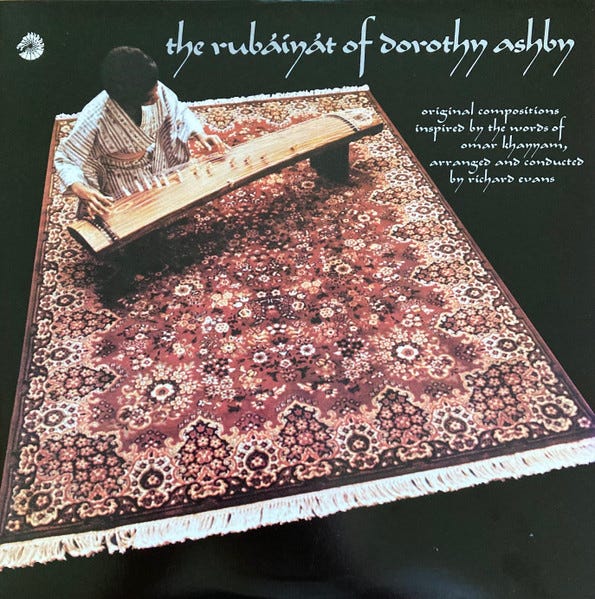
I must resist the temptation to go further on that global journey, at least for now. I’ve always loved kora music, though, and find myself inevitably exploring harp/kora duets such as the collaboration between Catrin Finch and Seckou Keita.
My year ends as it began, in Cornwall. I listen to Mary Lattimore albums as I drive the country lanes and coastal roads. Then I listen to Lattimore through other artists’ ears. The Hundreds of Days remix album. Sometimes the harp is lost in the mixes as other textures and beats steal into the foreground. But always the sense of the harp as structuring logic or as seed for what these tracks become. The notes on the album’s Bandcamp page note the ‘mesmeric, sun-kissed stomp’ that Julianna Barwick makes of ‘Never Saw Him Again. ‘Lattimore’s signature drone and halcyon flutter obscure and throb under the new tempo, evoking the optimistic glow of a golden hour in California, where both artists reside’. I’ve never been to California, but I’ve basked in the golden light of Cornwall, have known that glow you feel inside and out as late afternoon sun glints on surf and endless waves meet endless sand.
A late-year rediscovery as I go through the 2025 album lists. Djrum, the project of British DJ and producer Felix Manuel. I’d picked up on his previous music, but hadn’t played this year’s Under Tangled Silence enough to become familiar. I choose it as the soundtrack to a Boxing Day run, Manuel’s skittering beats adding weird cadences to my ragged route along a Cornish mining trail. Harp sounds glisten through the electronics.
UK rapper Dave refers to the ancient axe in his 2025 album The Boy Who Played the Harp. Already deep in harp reverie when the album came out in October, I hoped the instrument would feature as a sound on the album, and it does. It’s there in the background of Dave’s duet with Kano, ‘Chapter 16’ (aka ‘Legacy’ on my vinyl version). The harpist is Eleanor Turner, who also features elsewhere on the album. There’s a harp (and a different harpist) in the background of the one-shot video too.
The Book of Samuel. Chapter 16. Kano as Saul, Dave as David. Legacy passed on, anointment made. ‘God loves a trier, David loves a lyre / But even a harp’s half a heart, so why could Cupid fire?’
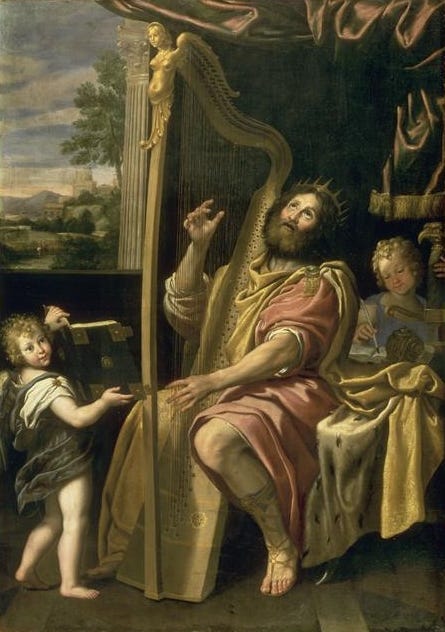
The title track of Dave’s album doesn’t feature the sound of a harp, but the lyrics refer again to David’s performance for Saul and for God, the same one Leonard Cohen alluded to in ‘Hallelujah’. On Dave’s song, as elsewhere on the LP, piano seeps through. Echoes of Satie. In this year when Ian Penman’s book on Satie had me listening to hours of the composer’s music, it all connects.
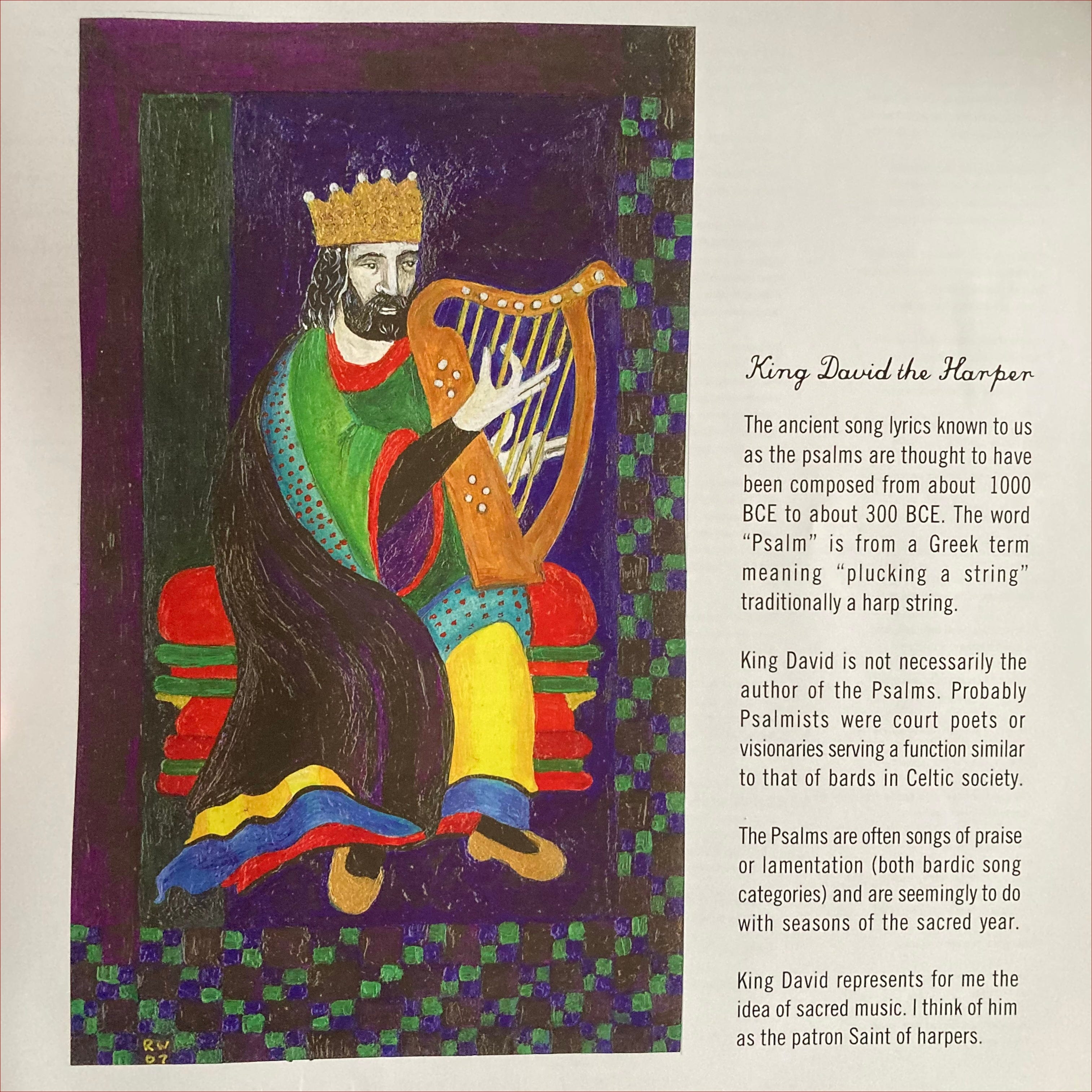
Robin Williamson’s Love Will Remain comes with a booklet of paintings, lyrics and notes. One of the paintings is King David the Harper.
A 1990 concert by Robin Williamson is filmed and released by Shanachie as a VHS video. It disappears, a victim of format change. In 2017 it emerges on YouTube. An hour and ten minutes of the kind of genius I witnessed all those years ago in Devon, albeit shorn of a few instruments. There’s still harp and twelve-string guitar, pennywhistle and sound effects as Williamson spins his tall tales. It ends, as Songs of Love and Parting ends and as all good gatherings should, with ‘The Parting Glass’.
Playlist
I’ve made a playlist to accompany this piece.
Qobuz (non-embeddable): https://open.qobuz.com/playlist/35944114.
Spotify (almost the same: no Joanna Newsom currently on Spotify):
There’s also this (not currently on Qobuz):
Erik Davis, ‘Joanna Newsom: Always Coming Home’, Arthur no. 25 (2006), https://arthurmag.com/2006/12/23/nearer-the-heart-of-things-erik-davis-on-joanna-newsom-from-arthur-no-25winter-02006.
Jay Babcock, ‘Forty-Six Strings and Some Truths’, Arthur no. 10 (May 2004), https://arthurmag.com/2010/01/28/forty-six-strings-and-some-truths-a-conversation-with-joanna-newsom-2004/.
Laura Cannell, interview with Luke Turner, the Quietus (9 May 2025), https://thequietus.com/news/laura-cannell-interview-sutton-hoo-lyre/.
Very interesting, thank you.
Most of that is slightly outside of my musical knowledge/familiarity but, of the pieces I listened to, I really enjoyed "Feeling Good"